

Linux Epoll
Overview
Epoll is a Linux kernel feature used by programs to check when multiple file descriptors are ready for I/O.
Internally, epoll revolves around a kernel object called eventpoll.
Key Components of eventpoll Object
The eventpoll structure is the main kernel data structure used to implement an epoll instance.
It contains several internal data structures that together manage file descriptor registration, event notification, and process sleeping and wake-up.
struct eventpoll {

/* Wait queue for sys_epoll_wait() */
    wait_queue_head_t wq;

/* List of ready file descriptors */
    struct list_head rdlist;

/* Red-black tree root used to store monitored file descriptors */
    struct rb_root_cached rbr;

/* Lock protecting eventpoll internal data structures from race conditions */
    spinlock_t lock;

/* ... other fields ... */
};
The lock field is a spinlock used to serialize access to shared eventpoll state. See Spinlock in the glossary for details.
1. The Wait Queue (wq)
The wait queue stores references to processes or threads that have called epoll_wait() and are currently blocked inside the kernel.
When a thread calls
epoll_wait()and there are no ready events, the kernel:- Adds the calling thread to this wait queue.
- Puts the thread to sleep.
The thread remains in the wait queue until one of the following occurs:
- An event happens on a monitored file descriptor.
- The timeout specified in
epoll_wait()expires.
When an I/O event occurs on any monitored file descriptor:
- The kernel wakes up the thread sleeping in this wait queue.
2. The Ready List (rdlist)
The ready list is a doubly linked list that contains entries for file descriptors that have pending events.
Each entry in the ready list corresponds to a monitored file descriptor for which at least one registered event condition is currently true (for example, data available to read).
When the kernel detects an event on a monitored file descriptor:
- The corresponding entry is added to the ready list.
When
epoll_wait()is called:- The kernel checks whether the ready list is empty.
- If it is not empty, the kernel copies event information from the ready list into the user-provided buffer and returns immediately.
After events are reported:
- Entries may be removed from the ready list, depending on whether the file descriptor is using level-triggered or edge-triggered mode. This will be explained later in this document.
3. The Red-Black Tree (rbr)
The red-black tree stores all file descriptors registered with the epoll instance, regardless of whether they are currently ready.
- Each node in the tree corresponds to one monitored file descriptor and contains the information epoll needs to monitor track that file descriptor.
- This tree allows the kernel to:
- Quickly find a file descriptor when an event occurs.
- Efficiently add, modify, or remove file descriptors.
Operations on this tree occur when epoll_ctl() is called with the following flags :
EPOLL_CTL_ADDused for inserting a new node.EPOLL_CTL_MODused for updating an existing node.EPOLL_CTL_DELused for removing a node.
Because the structure is a red-black tree, these operations have O(log n) time complexity.
The red-black tree represents the complete set of monitored file descriptors, while the ready list represents only the subset that currently have events.
How it works: The Lifecycle
Creating an Epoll instance: epoll_create1()
int epoll_create1(int flags)This call returns a file descriptor representing the epoll instance. The descriptor is later used with epoll_ctl() to register file descriptors and with epoll_wait() to receive readiness events.
flags : The flags argument controls properties of the epoll file descriptor itself.
EPOLL_CLOEXEC: Sets the close-on-exec (FD_CLOEXEC) flag on the epoll file descriptor. When the process calls exec(), the kernel automatically closes the epoll descriptor, it from being inherited by the new program image.
0: Creates the epoll instance without setting FD_CLOEXEC. In this case, the epoll file descriptor is inherited across fork() + exec(), which can unintentionally leak the instance into child processes.
In almost all applications, especially servers and multi-process programs, EPOLL_CLOEXEC should be used to avoid file descriptor leaks.
Registering a File Descriptor with Epoll: epoll_ctl()
#include<sys/epoll.h>
int  epoll_ctl(int  epfd, int  op, int  fd, struct epoll_event *event);
epoll_ctl() is used to add, modify, or remove a file descriptor from an epoll instance.
It defines which file descriptor to monitor and which I/O conditions on that file descriptor should generate events.
Arguments
epfd: A file descriptor referring to an epoll instance, as returned byepoll_create1().op: The operation to perform on the epoll instance:EPOLL_CTL_ADD– register a new file descriptor.EPOLL_CTL_MOD– change the event settings for an already registered file descriptor.EPOLL_CTL_DEL– remove a file descriptor from monitoring.
fd:
The target file descriptor to monitor.
This is typically a socket, pipe, or other I/O object that supports polling.event
A pointer to a user-definedstruct epoll_eventthat specifies:- The I/O conditions the kernel should monitor for the file descriptor
fd(for example, readiness for reading or writing) - A user-defined value that will be returned to user space when an event occurs. For example, an application may store the file descriptor itself or a pointer to another structure in
epoll_event->data.
- The I/O conditions the kernel should monitor for the file descriptor
User-Space Event Specification: struct epoll_event
The epoll_event structure is a data structure defined in <sys/epoll.h> that a program uses to tell the kernel which events it wants to monitor for a file descriptor and what data should be returned when those events occur.
struct epoll_event {
	uint32_t events; /* Epoll events (eg: EPOLLIN,EPOLLOUT,EPOLLET) */
	epoll_data_t data; /* User data variable */
};

union epoll_data {
	void *ptr; /* Pointer to a user defined data structure */
	int fd; /* File descritor of the socket we are monitoring*/
	uint32_t u32; /* Not used within the scope of this project */
	uint64_t u64; /* Not used within the scope of this project */
};

typedef  union epoll_data epoll_data_t;
NOTE
The epoll_data_t union is defined and passed to the kernel by the programmer. So, when the kernel returns an event, this data can be used to identify which file descriptor triggered it—for example, to distinguish between a listening socket and a connection socket. In later stages, we will use the void *ptr field instead of the file descriptor to handle this logic.
When epoll_ctl() is called:
- The kernel copies the contents of this structure and stores the copied data internally as part of the epoll instance.
- User space does not directly access or modify the kernel’s internal copy after registration.
The events Field
The events field is a bitmask that specifies which I/O readiness conditions should generate notifications for the file descriptor.
Common event flags include:
EPOLLIN
Indicates that the file descriptor is ready for reading.
For example:- Data is available to read on a socket.
- A read operation will not block.
EPOLLOUT
Indicates that the file descriptor is ready for writing.
For example:- There is sufficient buffer space to send data.
- A write operation will not block.
EPOLLET
Enables edge-triggered notification behavior.
With this flag, events are reported only when the readiness state of the file descriptor changes.
Multiple event flags can be combined using the bitwise OR operator:
event.events = EPOLLIN | EPOLLOUT | EPOLLET;User Data Field: epoll_data_t
The data field lets a program store certain values/struct along with a monitored file descriptor.
- The kernel does not use or modify this value/struct.
- The same value is returned by
epoll_wait()when the file descriptor generates an event. - The program uses this value to determine which file descriptor or connection caused the event.
Kernel-Side Registration (EPOLL_CTL_ADD)
When a file descriptor is added using:
epoll_ctl(epfd, EPOLL_CTL_ADD, fd, &event);`The kernel performs the following steps:
Searches the epoll instance’s red-black tree to check whether the file descriptor is already registered.
If not found, allocates a new internal entry (
struct epitem).Copies the user-provided
struct epoll_eventinto the kernel-ownedepitem.Inserts the new
epiteminto the red-black tree for efficient lookup.
Internal Kernel Representation: struct epitem
struct epitem is the kernel’s internal representation of a single file descriptor registered with an epoll instance.
Each epitem corresponds to one (epoll instance, file descriptor) pair.
struct epitem {
	struct rb_node rbn; // for red-black tree

	struct list_head rdllink; // for ready list

	struct epoll_filefd ffd; // target fd + file pointer

	struct eventpoll *ep; // back-pointer to eventpoll

	struct epoll_event event; // user's event mask

	struct list_head pwqlist; // poll wait queue links
};
Field descriptions
rbn: Links the entry into the epoll instance’s red-black tree, which stores all registered file descriptors.rdllink: Links the entry into the ready list when the file descriptor has pending events.ffd: Stores the target file descriptor and its associated kernel file object.ep: Points back to the epoll instance that owns this entry.event: Contains a copy of the user-provided event mask and user data.pwqlist: tracks the kernel callbacks that notify epoll of state changes for this file descriptor. See the description below (ep_poll_callback()).
NOTE
The epitem structure is a completely internal kernel data structure.
It is not user-facing, not exposed through any system call or header, and exists solely for the kernel’s internal bookkeeping of monitored file descriptors within an epoll instance.
The Internal Working of Kernel Callback: ep_poll_callback()
This information is not required to use epoll in the user level as it is completely internal to the kernel.
When a file descriptor is registered with epoll, the kernel registers an internal callback function, ep_poll_callback(), on the file’s poll wait queues. This callback is invoked by the kernel whenever the file’s I/O state changes, such as when data becomes available to read or when buffer space becomes available for writing.
The purpose of ep_poll_callback() is not to determine which specific event occurred or to return events to user space. Its role is limited to notifying the epoll subsystem that the state of a monitored file descriptor may have changed.
When ep_poll_callback() is invoked, it first identifies the epitem corresponding to the file descriptor where a state change occurred. It then checks whether this epitem has already been recorded as ready. If it has not, the callback inserts the epitem into the epoll instance’s ready list (rdlist). This step ensures that each ready file descriptor is recorded only once until it is processed by epoll_wait().
After updating the ready list, the callback wakes up any processes or threads that are currently sleeping in epoll_wait() on the same epoll instance. This wakeup causes those processes to resume execution inside the kernel and recheck the ready list.
Importantly, ep_poll_callback() does not evaluate event flags such as EPOLLIN or EPOLLOUT. Instead, it merely signals that a state change has occurred.
In summary, ep_poll_callback() acts as a notification mechanism that records potential readiness and triggers wakeups, while the final event filtering and delivery are handled by epoll_wait().
Waiting for Events: epoll_wait()
This system call blocks the process until any of the descriptors being monitored becomes ready for I/O events. And the process is woken up when the ready list is non-empty (via the kernel callback ep_poll_callback()).
#include <sys/epoll.h>
int epoll_wait(int epfd, struct epoll_event *events, int maxevents, int timeout);
Arguments:
epfd: The file descriptor of the epoll instance.events: A pointer to an array ofepoll_eventstructures (this array need to be allocated in the user space). The kernel will store the events that occurred in this array.maxevents: The maximum number of events epoll_wait() may return in a single call. The kernel copies events from the epoll ready list (rdlist) until either the list is exhausted or maxevents entries have been filled. If more file descriptors are ready, they remain in the ready list and are returned by subsequent calls to epoll_wait().timeout: The maximum time (in milliseconds) to block. Iftimeoutis0, the call will return immediately. Iftimeoutis-1, the call will block indefinitely.
Internally: How epoll_wait() Works in the Kernel
When a process calls epoll_wait(), execution enters the kernel and operates on the eventpoll structure associated with the epoll file descriptor.
The kernel first acquires the epoll instance’s internal lock to serialize access to its shared state. It then checks the epoll instance’s ready list (rdlist), which contains entries (epitem objects) for file descriptors that have already been marked as ready by the kernel.
If the ready list is not empty, the kernel does not put the process to sleep. Instead, it immediately proceeds to copy event information from the ready list into the user-supplied events array. For each ready entry, the kernel copies the stored struct epoll_event from the corresponding epitem until either the ready list is exhausted or the maxevents limit is reached.
If the ready list is empty, the kernel prepares to block the calling process. The process is added to the epoll instance’s wait queue (ep->wq), and the scheduler puts the process to sleep. At this point, the process does not consume CPU time and remains blocked inside epoll_wait().
While the process is sleeping, monitored file descriptors may change state. When such a change occurs, the kernel invokes the epoll callback function (ep_poll_callback()). This callback does not return events to user space directly. Instead, it marks the corresponding epitem as ready by inserting it into the epoll instance’s ready list and then wakes up any processes sleeping in the epoll wait queue.
Once the sleeping process is woken, execution resumes inside epoll_wait(). The kernel again acquires the epoll lock and rechecks the ready list. If entries are present, the kernel iterates over them and copies their associated struct epoll_event data into the user-space events array.
After copying events, the kernel updates the ready list based on the triggering mode. This will be explained below.
Finally, the kernel releases the epoll lock and returns to user space, with epoll_wait() returning the number of events copied into the events array.
Note: epoll_wait() itself does not detect I/O readiness; it only consumes events that were previously recorded in the ready list by kernel callbacks.
Level triggered mode (LT)
In level-triggered mode, epoll reports a file/socket descriptor as ready as long as the readiness condition persists. For EPOLLIN, readiness indicates that unread data is present in the kernel’s receive buffer; for EPOLLOUT, it indicates available space in the kernel’s send buffer. The file descriptor is returned by epoll_wait() on every call while these conditions remain true.
That is, if a file/socket is reported as ready to read by epoll_wait(), the user space code will read data from the file/socket into a user buffer. Suppose that the user buffer gets filled up, but there is still unread data in the file's/socket's kernel buffer. In level-trigerred mode, the descriptor continues to be maintained in the ready list and the next call to epoll_wait() will continue to notify the file/socket as ready to read. On the other hand, if the complete data in the kernel buffer is read into user space, the file/socket will be removed from the ready list (and will get back into the ready list only if new data arrives in the file/socket).
If a file/socket is notified as ready for write, it will continue to be maintained in the ready list and notified in each invocation of epoll_wait() as long as its kernel buffer has remaining free space.
As a result, level-triggered mode reflects the current I/O state of the file/socket descriptor rather than changes in that state, which can lead to repeated notifications if the application does not complete the required I/O operations.
Edge triggered mode (ET)
In edge-triggered mode, epoll reports events only when the readiness state changes (for example, when new data arrives on a socket that was previously empty). Once the event is delivered, epoll will not notify again until another state change occurs.
Because Edge triggered mode does not repeat events, the application must read or write into the file/socket until the kernal buffer is empty/full - identified when read()/write()/recv()/send() system call returns EAGAIN. In edge triggered mode, a descriptor that is notified once by epoll_wait() to the user space will no longer continue in the ready list. A monitored descriptor will re-enter the ready list only when new data arrives (and ep_poll_callback() places the file descriptor again into the ready list).
Edge triggered mode reduces unnecessary wakeups and is useful for high-performance servers, but requires more careful application side programming. This mode is enabled by passing the EPOLLET flag when registering the file descriptor with epoll_ctl().
NOTE
EAGAIN is a common error code returned by non-blocking I/O operations (e.g., read, write, recv, send) when the operation cannot be completed immediately without blocking the calling process. In the context of epoll with non-blocking sockets, especially in Edge-Triggered mode, receiving EAGAIN indicates that there is no more data to read or the write buffer is full, and you should stop attempting the operation until a new event is reported by epoll_wait().
Epitem Lifecycle
Each epitem (monitored FD) transitions through three stages:
| Stage | Description |
|---|---|
| Registered | In red-black tree, not ready yet |
| Ready | Added to ready list after kernel callback |
| Delivered | Returned by epoll_wait() to user space |
Lifecycle of an Epoll Readiness Event
When a socket receives new data:
- The network stack updates its
sk_buffqueue. - The socket’s
poll()function returnsPOLLIN. - Epoll’s registered callback (
ep_poll_callback) runs. - The corresponding
epitemmoves tordlist. - If a process is sleeping in
epoll_wait(), it’s woken up. - Events are copied to user space, and control returns to the application.
Summary Table
| Component | Data Structure | Purpose |
|---|---|---|
| Interest list | Red-black tree (rbr) | Store registered FDs |
| Ready list | Linked list (rdlist) | Store active events |
| Wait queue | wait_queue_head_t | Put sleeping processes |
| FD node | epitem | Connects file to eventpoll |
| Callback | ep_poll_callback() | Moves item to ready list + wakeup |
Summary of chain of events:
When an application calls epoll_wait(), it essentially hands control to the kernel, asking it to monitor all file descriptors that were previously registered through epoll_ctl(). Inside the kernel, each epoll instance is represented by an eventpoll object, which contains three key components — a red-black tree (holding all registered file descriptors), a ready list (containing file descriptors that currently have pending I/O events), and a wait queue (where user processes sleep when there are no ready events). When epoll_wait() is invoked, if the ready list is empty, the calling process is put to sleep on the wait queue. When data arrives or an I/O state changes on any of those file descriptors, the kernel triggers the registered callback ep_poll_callback(). This callback runs in interrupt or softirq context, adds the corresponding epitem (representing that FD) to the eventpoll’s ready list, and then wakes up any processes sleeping on the epoll’s wait queue. Once the sleeping process wakes, epoll_wait() copies the list of ready events from the kernel’s ready list into user-space memory and returns control to the application with a list of file descriptors that are ready for I/O.
Workflow of epoll_wait() : 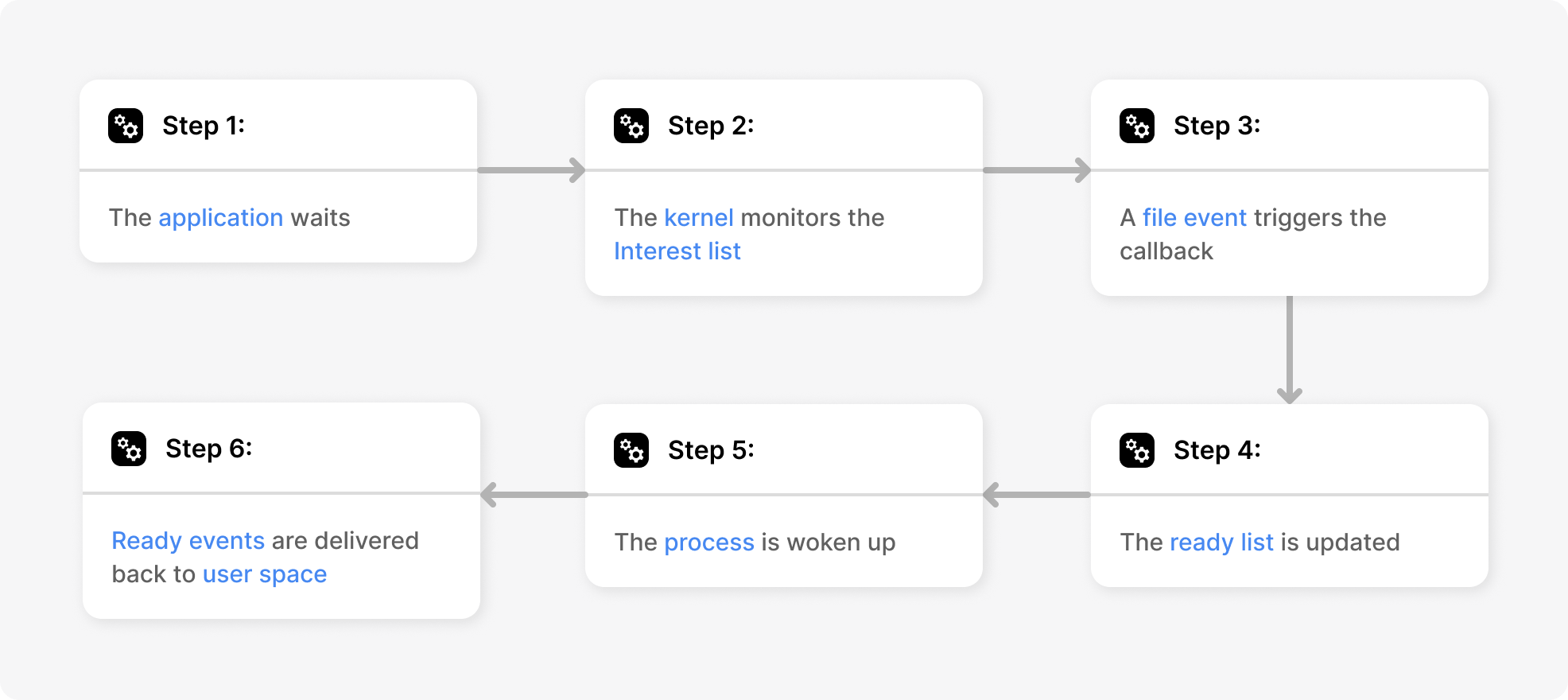
Glossary
Callback
A callback is a function inside the kernel that is registered to be run automatically when a certain kernel condition occurs. In epoll, the callback is used to inform the epoll subsystem that the state of a monitored file descriptor has changed.
When a file descriptor is added to epoll using epoll_ctl(EPOLL_CTL_ADD), epoll registers its own internal function, ep_poll_callback, using the file’s poll() mechanism. This function is stored in kernel data structures associated with that file descriptor. When the file becomes readable, writable, or otherwise changes state, the kernel runs this callback.
The callback runs entirely inside the kernel and is not called by user code. Its job is only to record that the file descriptor is ready and to wake up any threads waiting in epoll_wait(). It does not decide which events occurred and does not return data to user space. Because it may run in interrupt or softirq context, the callback is not allowed to sleep.
Spinlock
A spinlock is a low-level kernel synchronization primitive used to protect shared data structures from concurrent access. When a CPU attempts to acquire a spinlock, it repeatedly checks the lock until it becomes available, without putting the current execution context to sleep.
Spinlocks are used in epoll because parts of the epoll subsystem, including callbacks, may execute in interrupt or softirq context where sleeping is not allowed. Epoll uses spinlocks to protect short critical sections, such as updates to the ready list or internal bookkeeping structures. Because spinning consumes CPU time, spinlocks must be held only for very short durations.
Note: The use of spinlock by epoll is completely within the kernel context and there is no application involvement.
Interrupt Context (Hard Interrupt Context)
Interrupt context is a kernel execution context entered when the CPU receives a hardware interrupt from a device such as a network card, disk controller, or timer. When an interrupt occurs, the CPU immediately suspends the currently running code, switches to kernel mode if necessary, and begins executing the registered interrupt handler.
Code running in interrupt context is not associated with any user process or kernel thread. Because interrupt handlers must execute quickly and predictably, strict rules apply: sleeping, blocking, acquiring sleep-based locks, and accessing user-space memory are forbidden. Only minimal work is performed in interrupt context, such as acknowledging the interrupt and scheduling deferred processing.
In the context of epoll, interrupt handlers do not directly invoke epoll logic. Instead, they typically schedule deferred work that later leads to epoll callbacks being triggered.
Softirq Context
Softirq context is a kernel execution context used to perform deferred work that was triggered by a hardware interrupt but could not be completed safely or efficiently within the interrupt handler itself. Softirqs allow the kernel to defer processing while still executing soon after the interrupt and without sleeping.
After a hardware interrupt schedules a softirq, the kernel executes the softirq either immediately after the interrupt handler returns or at a later point, depending on system load. Like interrupt context, softirq context is not associated with a user process and forbids sleeping, blocking, or acquiring mutexes.
In networking and I/O subsystems, softirqs handle tasks such as packet processing and socket state updates. When a socket’s state changes during softirq processing, epoll’s callback may be invoked. Because this execution path may run in softirq context, epoll callbacks are designed to perform minimal work, use spinlocks, and avoid sleeping, while deferring event delivery to epoll_wait().